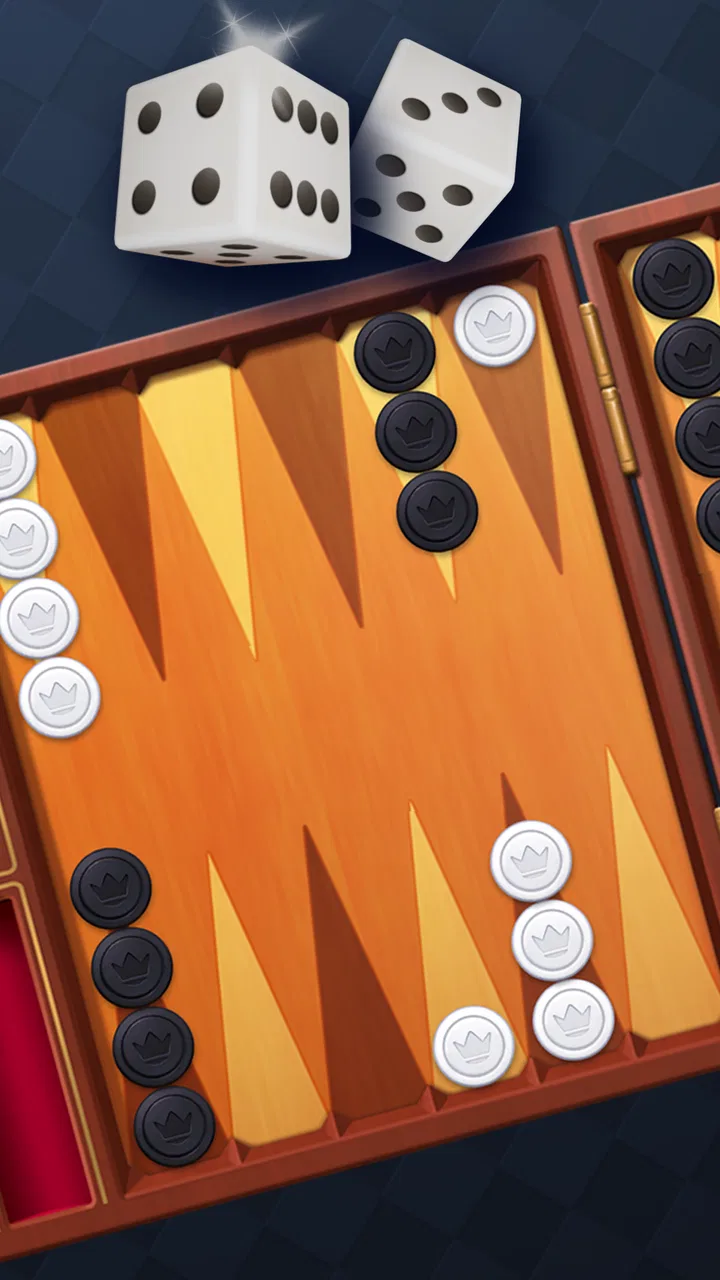
Backgammon: Dice Board Game
- 4.5
- Rating
- 1.00M
- Installs
- Free
- Price

 Analysis by App-foxy
I started playing Backgammon: Dice Board Game expecting a quick way to pass a few spare minutes, and that is exactly where it fits best. It takes the familiar board game and puts the important decision in front of me immediately: roll the dice, study the available moves, and decide whether to play safely or take a calculated risk. There is no long introduction to get through before the board becomes interesting.
That simple first action is also the reason this game remains approachable. Backgammon is easy to recognize, but a good move is rarely automatic. I can use a roll to advance a single piece, split the result between two pieces, protect a position, or expose a checker in exchange for a better attack. The rules are compact enough for a newcomer to understand, while the consequences of each choice give experienced players something to think about.
Developed by Blackout Lab, this free board game belongs to the kind of app I can open without planning a full evening around it. It is rated for Everyone, and the broad age rating makes sense: the presentation is centered on dice, checkers, movement, and the changing state of the board rather than complicated themes. On Android, it runs from version 7.0 onward, which also makes it suitable for older devices that cannot use every recent game.
You May Also Like

 Blood Strike: 2.5 Anniversary
Blood Strike’s Loadouts Turn Every Drop Into a Tactical Gamble
A close look at Blood Strike’s custom loadouts: how fast access to signature weapons reshapes its battle royale rhythm, rewards preparation, and narrows the gap between fights.

 Pandora - Music & Podcasts
Pandora’s Music Is Easy to Start, but Harder to Recover
Pandora’s strength is its low-effort path from a seed to a station. Its weak spot is how much confidence it asks you to place in connection, setup, and quiet recovery.

 8 Ball Pool
 Is Built on Rivalries, Rematches, and Routine
A close look at the rivalries, rematches, shared routines, and unanswered safety questions that turn a quick pool match into a persistent mobile community.

 Samsung Music
’s Quiet Strength Is Playing What You Already Own
Its reach comes less from spectacle than from dependable access to a personal library. That simplicity is both the app’s strongest retention engine and its ceiling.

 AccuWeather: Weather Radar
AccuWeather Review: A Quick, Clear Forecast for Everyday Decisions
For everyday plans, the best forecast is the one you can understand quickly. AccuWeather makes rain timing, radar, and local conditions easy to act on, with a few trade-offs.

 Hill Climb Racing
Why Hill Climb Racing Still Turns Crashes Into One More Run
A tiny car, a bumpy hill and one more upgrade: Hill Climb Racing keeps resurfacing because its simple chaos makes every near-miss feel personal.
More From Our News Desk



How the backgammon loop feels in actual play
I find the appeal of backgammon in how each roll becomes a small planning problem rather than an instruction to move blindly. In this section, I’ll look at how that turn-by-turn rhythm rewards attention, while also showing why a convenient digital board can still feel different from playing across a table.
The first roll turns a familiar board into a decision
The opening roll is where the app earns my attention. I am not simply tapping through a fixed sequence. The dice give me a limited set of possibilities, and I have to interpret them against the current board. A strong opening can create a useful structure, but even an awkward roll may offer a way to improve my position if I look beyond the most obvious move.
For someone learning backgammon, this is a comfortable entry point because the board itself communicates the basic situation. My checkers, the opponent's checkers, open points, blocked paths, and exposed pieces all matter visually. I do not need to memorize a large collection of controls. The challenge comes from understanding what the legal moves mean and recognizing which one leaves me in the best position after the opponent's reply.
I found it useful to slow down before confirming a move, especially when a roll can be divided in more than one way. The first legal-looking option is not always the best one. A move that gains distance may also leave a checker vulnerable, while a defensive move may look less exciting but make the next turn easier. That small pause is one of the most practical habits this game encourages.
The dice also create a healthy tension between planning and adaptation. I can begin a turn with one idea, then receive a combination that changes the priority completely. Sometimes the right response is to build a blockade. Sometimes it is better to hit an exposed opposing checker. At other times, advancing toward the home board matters more than starting a fight. The app's value is not in hiding this complexity; it makes the familiar rules feel active with every roll.
Feedback arrives through the board, not through noise
The most satisfying feedback is the immediate change in position after a move. A checker advances, a point becomes occupied, a vulnerable piece is sent away from the main track, or a route toward bearing off becomes clearer. I can see the result of my choice before the next turn begins, which makes the game easy to follow even when I am still learning strategic ideas.
This rhythm gives each turn a clear shape: roll, inspect, move, reassess. The opponent's response then supplies the next piece of information. If I leave a checker exposed, I may discover the mistake quickly. If I build a strong defensive arrangement, I can see how it restricts the available routes. The feedback is not just a win or loss at the end; it is the gradual evidence that one decision is improving or damaging my position.
That rhythm is particularly useful during short sessions. I can play while waiting for an appointment or during a brief break and still feel that the time had a beginning, a middle, and a conclusion. The game does not require a large uninterrupted commitment to make one turn meaningful. At the same time, a quick session can become longer because every reply creates a new question: can I recover from that hit, protect this checker, or finish before the opponent creates a blockade?
One detail I appreciate is that backgammon gives mistakes a visible explanation. If I lose a checker after moving too aggressively, I can usually trace the problem to the position I created. That makes the game more educational than a purely luck-driven dice app. Chance determines the available numbers, but the board shows whether I used those numbers responsibly.
There is a trade-off here. Players who want constant action may find the measured pace too quiet. The excitement comes from anticipation rather than rapid animation or a stream of rewards. I would not choose it when I want an arcade-style burst of stimulation. I would choose it when I want a compact strategy game in which the feedback remains readable and connected to my decisions.
Why one completed game often leads to another
The reward is not limited to seeing a victory screen. Winning feels good, of course, but the more durable reward is understanding why the position turned in my favor. A successful hit, a well-timed escape, or a carefully built blockade can feel like a small lesson that I can apply in the next game. Even a loss can be useful when it exposes a habit, such as moving too many checkers forward without securing the points behind them.
This is where the app works better for me than a passive time-killer. I leave a game with a specific thought rather than only a score: I should have protected that checker; I rushed the race; I ignored the opponent's possible doubles; I had a safer move available. Those observations make the next opening feel different, even though the board and rules remain familiar.
A practical way to improve is to give each session one focus. I might concentrate on avoiding unnecessary blots, keeping a connected group of checkers, or recognizing when a race has become more important than attacking. I do not need a formal training mode to use this approach. The ordinary game supplies enough situations to test one idea at a time, and the short turn cycle lets me see the consequences without a long wait.
Another useful habit is to compare the move I wanted with the move that best protects my position. Backgammon often tempts me toward the most active play, but activity is not always progress. If the opponent has a strong chance to hit, a modest move can preserve more future options. This is one of the game's less obvious lessons, and the app presents it naturally because the board changes immediately after each choice.
For families, the Everyone rating makes it an easy game to share across age groups, although a younger player may still need help with the rules and with reading the dice as two separate movement opportunities. For adults, it works well as a low-pressure mental break. For regular backgammon players, it is a convenient digital board for casual practice, though it may not replace a dedicated competitive platform if advanced match tools or a large live community are the main priorities.
The reset is quick, but the lesson carries forward
When a game ends, the reset is part of the appeal. I can look back at the final position, notice where the match shifted, and start again without a complicated setup. The next board is not simply a continuation of the previous one. A new roll changes the opening, and that fresh uncertainty removes the feeling that one mistake has permanently spoiled the experience.
This reset also keeps losses manageable. If I make a poor decision early, I do not have to spend a long time defending an impossible position before getting another chance. The game can still punish careless play, but the overall cycle remains inviting: begin with a roll, build a position, respond to pressure, reach an outcome, and return to the opening with a better understanding of what I want to try.
That structure suits several everyday situations. I can play one game during a commute if I have a stable moment to focus, use a short break to work through a few turns, or settle into a longer session when I want more strategic concentration. I would avoid starting a match when I know I may need to leave immediately, because abandoning a thoughtful position is less satisfying than finishing it. The game is flexible, but it still rewards attention.
The free price lowers the barrier to trying it, especially for someone who already enjoys traditional board games but does not want to buy a physical set or find an opponent nearby. The large audience also suggests that this is not an obscure experiment: it has passed one million installs, carries a 4.5 average from roughly thirty-five thousand ratings, and has about three thousand written reviews. Those figures make it easier for me to treat the app as an established casual option rather than a temporary novelty.
Still, popularity does not remove the need to choose carefully. A player looking for a highly social experience may prefer a platform built around live matches and communication. Someone who wants a broad collection of board games may find a multi-game app more practical. A person who dislikes luck in strategy games may also become frustrated, because even excellent planning cannot control every roll. This title is strongest when I accept the mixture of probability and decision-making as the point of backgammon.
Where it sits among familiar alternatives
Compared with playing on a physical board, the app is faster to start and easier to use alone. I do not need to arrange checkers, find dice, or clear a table. That convenience makes it a good companion for private practice and casual sessions. The physical version still has advantages: it is more tactile, naturally social, and often better for teaching someone face to face. I see this game as a portable substitute, not a complete replacement for the atmosphere of a real board.
Compared with a generic dice game, it offers much more ownership over the outcome. A random roll begins the turn, but movement choices shape the position. That makes the experience more rewarding for me than simply hoping for a high number. Compared with a complex strategy game, it is much easier to enter because the rules stay focused on a single board and a small set of actions. The trade-off is that its depth comes from repeated judgment, not from a large technology tree, character system, or campaign.
It also differs from many quick mobile games because the central loop does not depend on collecting a long chain of items or learning a large menu of upgrades. The reason to continue is the next position and the chance to make a better decision. That is refreshing, but it means players who need constant unlocks or a strong sense of progression may find the experience modest. The reward is improvement in play, not an elaborate account-building journey.
The current version is 1.30.0, and I would keep the app updated through the normal platform process so the installed build stays aligned with the version offered by Blackout Lab. For a casual player, the important point is that the game remains easy to approach: it is free, rated for Everyone, and designed around the recognizable backgammon board rather than a complicated onboarding process.
Who should play it, and who should pass
I recommend it to anyone who wants a focused board game that can expand from a quick distraction into a thoughtful habit. It is especially suitable for a beginner who wants to learn by playing, a returning player who wants regular practice, or a family member looking for a simple game that does not depend on an elaborate theme. The compact rules make it approachable, while the changing positions leave room to develop better judgment.
I would be more cautious about recommending it to someone who needs guaranteed control over every outcome. Backgammon's dice can overturn a promising plan, and that uncertainty is fundamental rather than a flaw to be removed. I would also point competitive players toward a more specialized alternative if they require a strong tournament environment, detailed match analysis, or a clearly social live-play focus. This app is better understood as an accessible digital board for repeated casual and strategic games.
My most useful advice is to resist treating every roll as a command to move as far as possible. First check whether a checker will become exposed, then consider whether the move improves your next turn as well as the current one. When the opponent is close to bearing off, defensive structure may matter more than a tempting attack. When you are already ahead in the race, reducing unnecessary contact can be wiser than chasing another hit. These small choices are where the app becomes more than a dice simulator.
After spending time with it, I see the appeal in the complete cycle. The first roll creates a problem, the board gives immediate feedback, a good decision provides a modest but real reward, and the reset offers another chance to test what I learned. The best reason to begin another session is not a forced reward system; it is the feeling that one better choice could change the whole board.
Backgammon: Dice Board Game is therefore a strong fit for relaxed strategy on Android. Blackout Lab keeps the focus on the classic game, and the free entry point makes experimenting easy. It will not satisfy every player, particularly those seeking intense competition, rich social features, or a no-luck strategy experience. For me, though, its clear decisions, readable consequences, and quick return to a new match make it an enjoyable board-game companion that I can recommend without pretending it is something more complicated than it is.
FAQs for Backgammon: Dice Board Game
01What platforms is Backgammon: Dice Board Game available on?
Backgammon: Dice Board Game is available on both Android and iOS platforms. Users can download it from the Google Play Store for Android devices and the Apple App Store for iOS devices. The game is optimized to run smoothly on smartphones and tablets, offering a seamless gaming experience across all devices.
02Is Backgammon: Dice Board Game free to play?
Backgammon: Dice Board Game is free to download and play. However, it does offer in-app purchases that can enhance the gaming experience. These purchases can include additional boards, dice designs, and other premium features. Players can enjoy the core game without spending money, but some advanced features may require payment.
03Does Backgammon: Dice Board Game require an internet connection?
Backgammon: Dice Board Game does not require a constant internet connection to play. You can enjoy the game offline against AI opponents. However, an internet connection is necessary for online multiplayer modes, updates, and accessing leaderboards. This flexibility allows players to enjoy the game anytime, anywhere.
04Can I play Backgammon: Dice Board Game with friends?
Yes, you can play Backgammon: Dice Board Game with friends. The game features an online multiplayer mode that lets you connect with friends or other players worldwide. You can also invite friends to join private games, ensuring a personalized gaming experience. Additionally, local pass-and-play options are available for offline multiplayer fun.
05What is the learning curve for Backgammon: Dice Board Game?
Backgammon: Dice Board Game is designed to be accessible to both beginners and seasoned players. It includes a comprehensive tutorial and tips for newcomers, helping them grasp the rules quickly. The game also offers adjustable difficulty levels, allowing players to challenge themselves as they improve their skills, making it suitable for all experience levels.
Pros
- Classic gameplay with modern design.
- Intuitive controls enhance user experience.
- Multiplayer mode for global competition.
- Customizable boards and dice options.
- Frequent updates with new features.
Cons
- Occasional ads can interrupt gameplay.
- Requires internet for some features.
- Limited offline multiplayer options.
- Some in-app purchases are costly.
- Learning curve for beginners.

Backgammon: Dice Board Game
Gallery